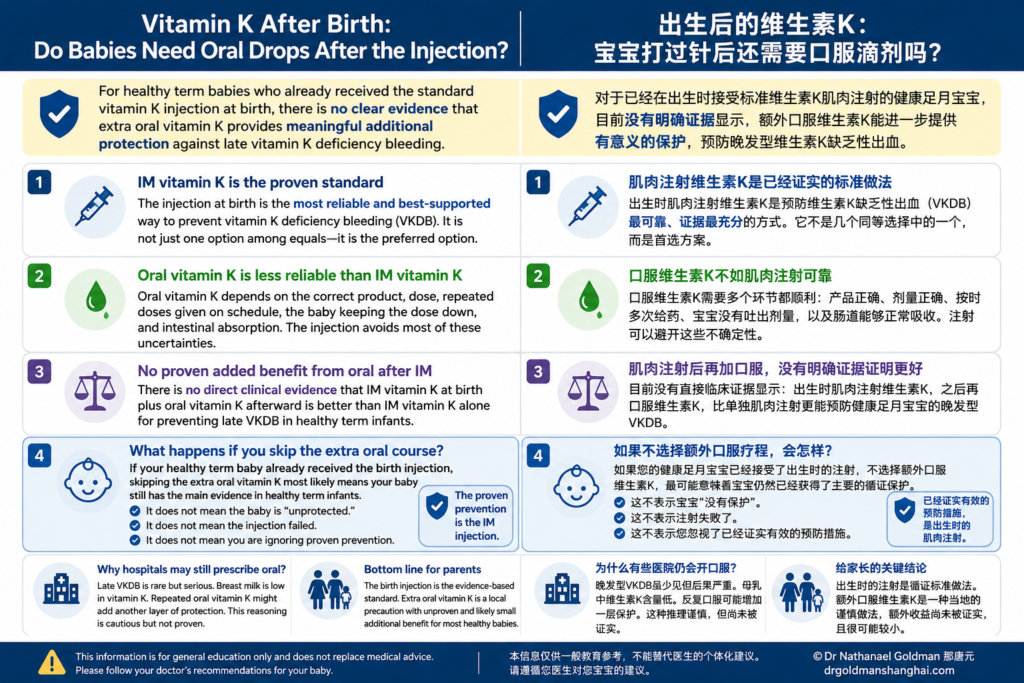
Some families in Shanghai are now being prescribed oral vitamin K drops for several weeks even though their baby already received the usual vitamin K injection at birth.
This can be confusing. In many countries, the standard recommendation is simple:
Give vitamin K once by intramuscular injection shortly after birth.
So parents naturally ask:
“If my baby already had the injection, do the oral drops add anything important?”
The clearest evidence-based answer is:
For healthy term babies who already received the standard vitamin K injection at birth, there is no clear evidence that extra oral vitamin K provides meaningful additional protection against late vitamin K deficiency bleeding.
The extra oral course should therefore be understood as a local precautionary practice, not as a proven necessity after a completed birth injection.
Why babies receive vitamin K
Vitamin K helps blood clot normally. Newborns are born with low vitamin K stores. Without enough vitamin K, a baby can develop vitamin K deficiency bleeding, also called VKDB or hemorrhagic disease of the newborn.
Late VKDB is rare, but it can be severe because bleeding may occur inside the brain. This is why newborn vitamin K prevention matters.
The injection is the proven standard
The best-supported prevention is the intramuscular vitamin K injection at birth.
This route is preferred because it is reliable: the baby receives the full dose, absorption does not depend on feeding, and parents do not need to remember repeated doses.
A simple way to understand it is:
The injection is not just one option among equals. It is the most reliable and best-supported option.
Oral vitamin K is less reliable than IM vitamin K
Oral vitamin K can reduce VKDB risk compared with no vitamin K, but it is not as dependable as the injection.
Oral vitamin K depends on several things going right: the correct product, the correct dose, repeated doses given on schedule, the baby keeping the dose down, and intestinal absorption.
The injection avoids most of these uncertainties.
This is why oral vitamin K is usually best understood as an alternative when IM vitamin K is not given, not as a routine add-on after IM vitamin K has already been completed.
Has oral vitamin K after IM vitamin K been proven to add benefit?
This is the central question.
The evidence clearly supports vitamin K prophylaxis, especially IM vitamin K at birth. The evidence also shows that oral vitamin K is less reliable than IM vitamin K.
But I have not found direct clinical evidence showing that:
IM vitamin K at birth + oral vitamin K afterward
is better than
IM vitamin K at birth alone
for preventing late VKDB in healthy term infants.
That matters. Without that comparison, the added oral course remains an unproven add-on, not an established evidence-based necessity.
So what happens if parents skip the extra oral course?
For a healthy term baby who already received the standard IM vitamin K injection at birth, skipping the additional oral course most likely means:
The baby still has the main evidence-based protection against VKDB.
It does not mean the baby is “unprotected.”
It does not mean the birth injection failed.
It does not mean parents are ignoring the proven prevention.
The proven prevention is the IM injection.
The extra oral course may be offered as an additional precaution by some hospitals, but its added benefit after IM vitamin K has not been shown clearly. Because IM vitamin K already reduces the risk dramatically, any extra benefit from oral drops is expected to be small and remains unproven.
A practical answer is:
If your healthy term baby received the birth injection, choosing not to give extra oral vitamin K is unlikely to remove the main protection your baby needs. The decision is mainly about whether you want to follow a cautious local add-on protocol whose additional benefit is uncertain.
Why might a hospital still prescribe oral vitamin K?
Some hospitals may be using a more cautious local protocol. Their reasoning may be:
Late VKDB is rare but serious.
Breast milk contains relatively low vitamin K.
Repeated oral vitamin K might provide ongoing intake.
Therefore, extra oral drops might add another layer of protection.
This reasoning is understandable, but it is an inference. It is not the same as evidence showing that oral vitamin K after IM vitamin K reduces VKDB compared with IM vitamin K alone.
What should parents take from this?
Parents should not be alarmed if oral vitamin K is offered. But they also should not be told that the birth injection was incomplete or inadequate.
A fair explanation is:
Your baby already received the most important and best-proven protection: the vitamin K injection at birth. Some hospitals recommend oral vitamin K afterward as an extra precaution, but for healthy term babies, its added benefit after IM vitamin K has not been proven and is likely small.
Bottom line
The evidence strongly supports IM vitamin K at birth.
The evidence also shows that oral vitamin K is less reliable than IM vitamin K when used for VKDB prevention.
For healthy term babies who already received IM vitamin K, I have not found direct clinical evidence that adding oral vitamin K afterward provides meaningful additional protection.
If a healthy term baby already received the birth injection, skipping the extra oral course does not mean skipping evidence-based VKDB prevention. The evidence-based prevention was the injection.
The added oral course is best understood as a cautious local practice with unproven and likely small additional benefit for most healthy babies.